
Why AI brand tracking needs a service comparison
AI search and assistant experiences are shaping how buyers discover brands, but traditional SEO tools often stop at web rankings. AI brand tracking goes deeper by measuring when and how your name appears in AI-generated answers. A proper service comparison helps you understand what AI Visibility Platform each vendor actually measures, how they collect data, and how they report it. When you evaluate options side by side, you reduce the risk of paying for vanity metrics that do not reflect real assistant citations.
Many teams also assume that “mentions” alone are the same as “visibility,” which leads to mismatched expectations. Some tools count occurrences without capturing whether the model cited sources, referenced pages, or attributed claims. Others focus only on one platform and miss how results differ across assistants. By comparing services around coverage and citation quality, you can pick a solution aligned with your go-to-market goals.
Coverage across major AI assistants and results surfaces
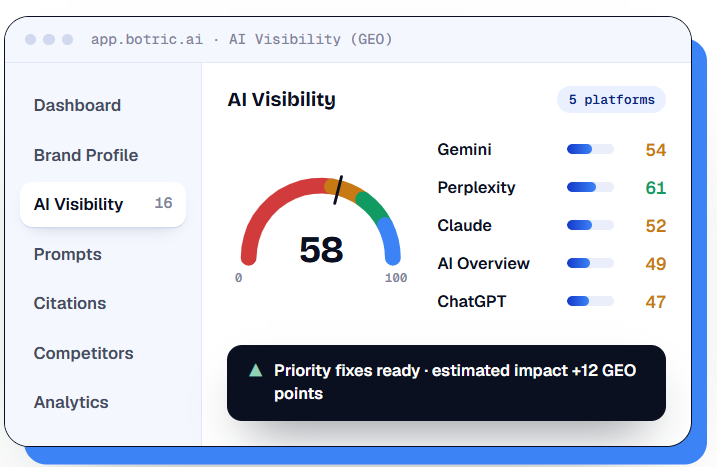
A strong AI brand tracking service should monitor multiple assistants that influence purchasing decisions. Instead of limiting measurement to one chatbot, look for tracking across experiences such as ChatGPT, Google AI Overviews, Gemini, Perplexity, and Claude. Each of these systems can surface different excerpts, use different retrieval methods, and interpret brand signals differently. When you compare services, verify the supported platforms and the consistency of their measurement approach.
Beyond assistant coverage, evaluate whether the tool distinguishes between answer types. For example, some systems may mention a company in a list, while others cite it as a supporting source in a paragraph. If one provider aggregates everything into a single number, you lose insight into how your brand is being framed. A better approach separates mention frequency, citation behavior, and context signals so you can act on what is working.
Also examine how tracking handles variations in queries. Brand visibility can change depending on whether users search by product name, category term, or competitor comparison. A service that uses a thoughtful query set can show patterns like “mentioned in high-intent contexts but not in educational ones.” When you compare platforms, check whether they document their query methodology and whether you can customize it to match your market.
Measurement depth: mentions vs citations vs brand lift signals
Not all AI visibility metrics are created equal, and the difference matters for decision-making. Mentions tell you that a brand appears, but citations often indicate stronger grounding and higher likelihood of influence. Some providers report citation rates, while others only show the frequency of name occurrences. If your goal is credibility and source-backed recommendations, prioritize services that evaluate citations and not just raw mentions.
You should also compare how each vendor defines “visibility” in reporting. One platform might equate visibility with mentions across assistants, while another measures visibility as a blend of mention frequency and citation quality. These definitions affect how you interpret improvements after campaigns or PR outreach. A clear scoring methodology helps you understand whether your efforts are driving brand authority or simply increasing surface-level recognition.
Look for additional context that connects measurement to action. For instance, a tool may show which pages or topics correlate with better citations, or which competitors are gaining share of assistant attention. Without that linking layer, a dashboard becomes a read-only artifact that does not guide next steps. The most useful comparisons focus on how the service translates AI visibility data into actionable insights.
Workflow fit: reporting, integrations, and team usability
Even the best measurement approach can fail if the reporting does not fit how teams work. Compare how dashboards are organized, how often you can export reports, and whether stakeholders can understand results quickly. Marketing leaders often want narrative-ready summaries, while analysts want drill-down views and reproducible logic. A service that supports both helps you avoid rebuilding insights manually.
Integrations can also make or break adoption. Check whether the tool can connect with common marketing workflows such as reporting sheets, analytics destinations, or CRM-informed campaigns. If your team already tracks brand performance elsewhere, the ability to align AI visibility metrics with existing KPIs can strengthen decision-making. In service comparisons, ask whether the vendor supports custom reporting dimensions and whether those dimensions remain consistent over time.
Usability matters for day-to-day monitoring as well. Look for alerting or change tracking that highlights significant shifts in mentions or citations across assistants. If you can spot deterioration early, you can address issues such as missing coverage, outdated references, or reduced source availability. When you compare offerings, prioritize features that support continuous monitoring rather than periodic manual checks.
Conclusion
Choosing an AI brand tracking service should start with a clear comparison of coverage, measurement depth, and practical usability. A reliable AI visibility tracker measures how often major AI assistants mention and cite your brand, then translates that data into context you can use. When you compare services carefully, you avoid overpaying for shallow metrics and instead select a platform that supports credible brand growth. Botric provides an AI visibility tracker designed to measure brand visibility across leading AI assistants, focusing on both mentions and citations. This service-comparison approach helps teams assess performance in the places where buyers actually encounter brands through AI-generated answers. If you want to make visibility improvements measurable and repeatable, start by evaluating how each platform measures outcomes and how well it supports action. That way, your reporting becomes a tool for strategy rather than a collection of numbers.

