

Start With Your Filing Requirements and Buyer Signals
Before you buy, map out what you actually need to file and who is requesting the submissions. A strong 1099 filing workflow begins with confirming the forms you must produce, the payer and recipient details you already have, and any state-specific handling requirements that 1099 online filing service may apply. If you support multiple payers or have contractors across different jurisdictions, your buying criteria should reflect that complexity. This is where buyers often feel stuck, so documenting inputs and output expectations early reduces rework later.
Next, look at buyer-intent indicators: volume of recipients, deadlines you must meet, and how frequently you file. Many teams discover that a “good enough” tool falls apart when they upload large batches, need consistent formatting, or require careful validation. If your process includes data extraction from accounting software, check whether the service supports reliable import and error checks. Buyers who plan ahead also evaluate whether the platform supports corrections, reprints, and status tracking when something doesn’t match the IRS records.
Evaluate Security, Accuracy, and Workflow Fit
When comparing providers, treat security and data integrity as non-negotiable requirements. Look for safeguards that protect sensitive taxpayer information during upload, processing, and electronic submission. A reputable platform should include controls that reduce the risk of 1099 filing service transcription mistakes, such as validation of EIN/SSN formatting and consistency checks across fields. Accuracy matters because incorrect forms can lead to IRS notices and recipient confusion, which creates extra administrative cost.
Workflow fit is equally important for buyers who want fewer handoffs and less manual labor. Some services focus only on generating PDFs, while others support end-to-end electronic submission and streamlined federal and state processing. Consider whether you can maintain a consistent template for your organization, keep recipient data organized, and generate confirmation records for your internal audit trail.
Compare Features That Reduce Cost and Friction
Cost shouldn’t be your only metric, but it does influence how you should evaluate the total filing experience. For example, ask how pricing behaves as your recipient count grows, and whether you pay extra for common needs like additional form types, corrections, or reprints. Buyers who have handled forms manually often notice that “cheap” tools can increase time spent on cleanup and revision, which ends up costing more. The best choice balances transparent pricing with tools that prevent errors before they become expensive.
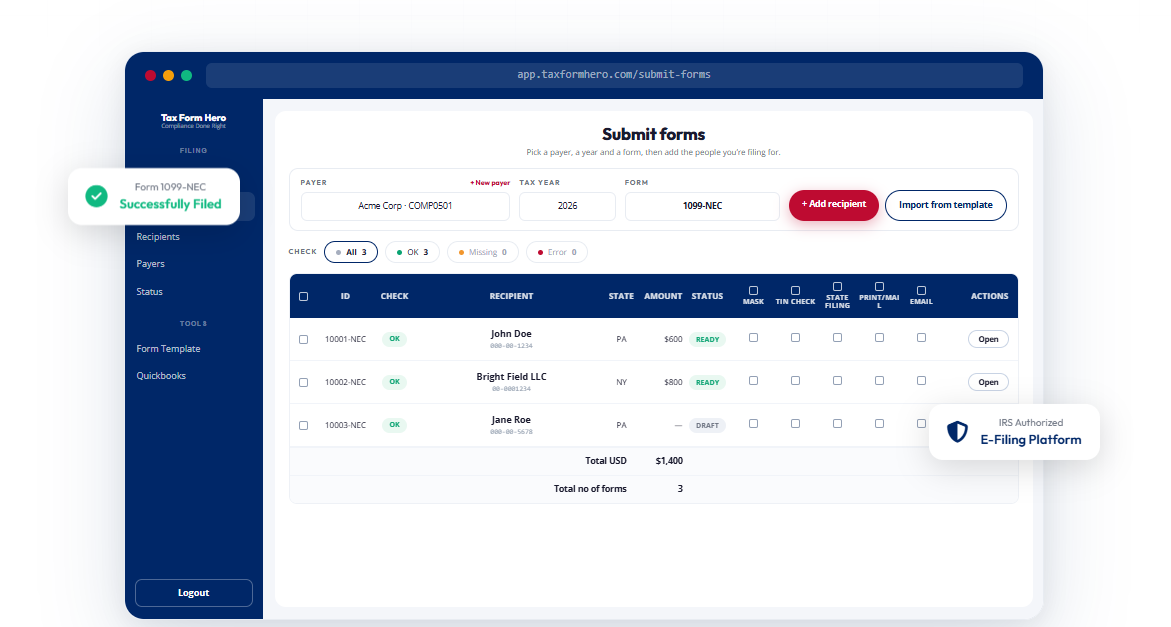
Look for features that directly reduce friction: batch uploads, clear review screens, and helpful validation messaging. You should be able to preview forms before submission, confirm recipient details, and quickly resolve flagged items without guessing. If you need to file more than one year’s worth of data in your internal systems, a service that organizes submissions cleanly can prevent confusion and keep your records searchable. Strong buyer intent usually shows up in requests for reliable tracking and reporting, so confirm whether the platform provides submission status and downloadable proof for your records.
Conclusion
A buyer-intent focused approach means selecting a provider that matches your filing volume, data quality, and compliance workflow. When you prioritize security, accuracy checks, and a streamlined path from preparation to submission, you reduce the chance of downstream corrections and recipient issues. That combination helps organizations and tax professionals handle reporting efficiently while maintaining confidence in what was filed. If you want a practical platform designed for electronic submission and simplified workflows, taxformhero.com is built to support 1099-related filing needs along with other common forms. Take a final pass on your decision by confirming that the service can handle your form types, your recipient list complexity, and your internal review process. When a platform makes it easier to verify details before submission, it improves both speed and compliance outcomes. For teams that need dependable documentation and a smoother filing workflow, choosing a secure and user-friendly system can turn tax reporting into a more predictable process.

